National Disability Employment Awareness Month: “Father of the Americans with Disabilities Act" Justin Dart Jr. (1930-2002)
In celebration of National Disability Employment Awareness Month, Cowan, Liebowitz & Latman invites you to learn more about Justin Dart Jr., widely known as the “Father of the Americans with Disabilities Act.”
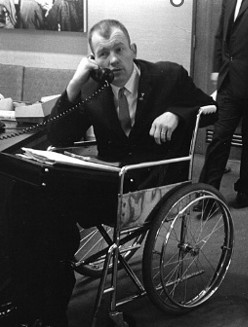
Author: National Museum of American History Smithsonian Institution, License: cc-by-sa-2.0 with sides cropped
Justin Dart Jr. was born in Chicago, Illinois on August 29, 1930. At age 18, he contracted polio, a life-altering illness that significantly affected his mobility and required him to use a wheelchair for much of his adult life.
Rather than allowing his disability to limit his aspirations, Mr. Dart became one of the nation's most influential advocates for disability rights and equal opportunity. His personal experiences with barriers and discrimination helped shape his belief that people with disabilities should be afforded the same civil rights, educational opportunities, and employment opportunities as all other Americans.
Following a successful business career, Mr. Dart became increasingly involved in disability advocacy during the 1970s and 1980s. He served as vice-chairman of the National Council on Disability, an independent federal agency charged with advising the President and Congress on disability policy. In 1986, the National Council on Disability issued Toward Independence: An Assessment of Federal Laws and Programs Affecting Persons with Disabilities–With Legislative Recommendations, a landmark report that recommended comprehensive equal opportunity legislation for individuals with disabilities. The report became the foundation for what would later become the Americans with Disabilities Act ("ADA").
Together with disability rights advocates across the country, Mr. Dart embarked on extensive nationwide listening tours, traveling to every state to gather testimony from individuals with disabilities and their families. During these visits, he listened to stories of discrimination in hiring, inaccessible workplaces, inadequate accommodations, and barriers to career advancement. These firsthand accounts helped lawmakers understand the significant employment and societal obstacles faced by people with disabilities and helped build momentum for comprehensive civil rights protections.
The Americans with Disabilities Act was signed into law by President George H.W. Bush on July 26, 1990. The ADA prohibits discrimination against qualified individuals with disabilities in employment, public services, public accommodations, and transportation. For the first time, many Americans with disabilities received broad federal protections against workplace discrimination and gained the right to request reasonable accommodations that would enable them to perform their jobs. Mr. Dart's advocacy, leadership, and ability to unite individuals, organizations, and policymakers played a critical role in advancing the legislation and securing its passage.
Following the enactment of the ADA, Mr. Dart continued to advocate for the full inclusion of people with disabilities in all aspects of society. He emphasized the importance of equal employment opportunities, economic self-sufficiency, and the recognition of disability rights as civil rights. Through speeches, mentorship, and continued public service, he inspired a new generation of disability rights advocates and encouraged people with disabilities to become active participants in shaping public policy.
Mr. Dart passed away on June 22, 2002, at the age of 71, but his legacy endures through the ongoing efforts to ensure that individuals with disabilities can participate fully in the workforce and in society.
Cowan, Liebowitz & Latman encourages you to recognize and promote diversity, accessibility, and inclusion every month.

Partner
Email | 212.790.9286
Ana is a patent attorney registered to practice before the U.S. Patent & Trademark Office.
She concentrates on patent and trademark counseling, patent preparation and prosecution in the areas of materials, mechanical and electro-mechanical technologies, such as optical devices and fuel cell systems and components.