

The U.S. Trademark Act prohibits the registration of marks that are likely to be confused with other marks that have either been registered with the U.S. Patent and Trademark Office (USPTO) or are in use by another entity in the United States. 15 U.S.C. §1052(d).
Generally, the word element is considered dominant in a composite mark consisting of words and design elements. However, such a mark can be found to differ sufficiently from a competitor’s mark if, for example, the word and design elements present a distinguishing cohesive narrative.
Background
USPTO tribunals assess the likelihood of confusion between two marks by employing the thirteen so-called DuPont Factors delineated in In re E. I. du Pont de Nemours & Co., 476 F.2d 1357, 1361 (CCPA 1973). Some of these factors are:
- the similarity of the marks themselves “as to appearance, sound, connotation and commercial impression.”
- the relatedness of the goods in the marketplace,
- the channels of trade in which the goods are sold,
- the nature of the consumers to whom the goods are sold,
- and the relative sophistication of the consumers.
The TTAB evaluates the overall impression to the average consumer rather than any specific factor. The TTAB has described the first DuPont factor—the similarity of the marks—as “critical.” Differences in the respective marks, especially when they incorporate both words and designs, sometimes can outweigh the other factors.
Two recent cases illustrate how the TTAB analyzes the relationship between textual and design elements in composite marks.
In re Malibu Shirts
Malibu Shirts, Inc. applied to register the below composite mark for hats, t-shirts, and sweatshirts. The Trademark Examining Attorney refused registration on the ground of a likelihood of confusion with two pre-existing registered marks for the abbreviations NWA and N.W.A., in standard characters, also for clothing.

Applicant appealed to the TTAB, which reversed the Examining Attorney’s refusal of registration.
The TTAB found that the goods were identical, and that the trade channels and classes of consumers were the same. Nonetheless, the TTAB reversed the refusal of registration, finding against a likelihood of confusion.
Rejecting the Examining Attorney’s assertion that the NWA initialism was the dominant element in Malibu’s mark, the TTAB found that consumers were just as likely to focus on the words “NORTHWEST AIRLINES” in tandem with “the wing-like design elements” of the mark as the NWA abbreviation itself. The TTAB particularly noted that “the design elements and additional wording in Applicant’s mark actually create in the minds of consumers a meaning of NWA—a reference to an airline—that is not present when NWA appears by itself.”
Accordingly, the TTAB concluded that the dissimilarity of the marks outweighed the other factors and that the marks were not likely to be confused.
In re Malibu Shirts, Inc., Application No. 98696754 (T.T.A.B. May 21, 2026).
Candy Dynamics, Inc. v. Aurox Distributors LLC
Aurox Distributors LLC filed an intent-to-use application to register the composite mark for candy shown below.

Candy Dynamics, Inc. opposed on a number of grounds, including that the mark was likely to be confused with its registered design mark for candy shown below.
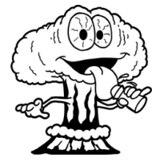
As in Malibu Shirts, the TTAB found that the goods were identical, and the channels of trade classes of consumers were the same. The TTAB also found that some consumers of candy were unsophisticated “impulse” buyers of inexpensive sweets who could easily be confused by similar marks. Each of these four factors favored a finding of likelihood of confusion.
However, the TTAB ultimately rejected Candy Dynamics’ challenge. The TTAB found that the words SOUR CITY dominated the Aurox mark, and that the character’s wide-open eyes and outstretched tongue suggested that it “ha[d] just eaten something extremely sour” and served to reinforce the phrase SOUR CITY. In contrast, the TTAB noted that Candy Dynamics’ mark included a mushroom cloud connoting toxicity.
While the TTAB acknowledged the general similarity of the characters in each mark, it credited evidence introduced by Aurox that “the shared elements of a character with a rounded head, wide-eyes and outstretched tongue” are commonly used motifs in connection with candy and not “unique” to Candy Dynamics’ mark.
In spite of the identical nature of the goods, their similar channels of trade and classes of consumer, and the relative lack of sophistication of sour candy consumers, the TTAB concluded that the marks’ dissimilarity in sound, appearance, connotation, and commercial impression was “pivotal” and “outweigh[ed] the other DuPont factors.”
Candy Dynamics, Inc. v. Aurox Distributors LLC, Opposition No. 91292159 (T.T.A.B. May 7, 2026)
Authors’ Note:
In Malibu Shirts, the TTAB found that the term NORTHWEST AIRLINES operated in tandem with the wing design to dominate the composition and imbue NWA with a specific definition—that of an airline—in the mind of the consumer.
Similarly, in Candy Dynamics, SOUR CITY informed the consumer’s understanding of the meaning of the character’s expression as one related specifically to sourness, in contrast to the toxic connotation of Aurox’s mark.
In each case, the textual and design elements reinforced each other and presented a unified commercial impression that distinguished the Applicant’s mark from its competitor’s mark.
For further information, please contact Victoria Thede, William M Borchard or your CLL attorney.
 Associate
Victoria is a commercial litigator with a focus on intellectual property.
 Senior Counsel
Bill has handled domestic and international trademark and copyright matters at the highest level for over 60 years. He has counseled and represented clients on domestic and international trademark matters concerning clearance ...
 RSS Feed
 Follow us on Facebook
 Follow us on X/Twitter
 Follow us on LinkedIn