
A “deceptively misdescriptive” mark is a mark that merely describes an aspect of the goods or services for which it is used. However, those goods or services do not in fact possess that aspect (misdescription) although consumers are likely to believe they do (deception).
Such a mark cannot be registered on the Principal Register of the U.S. Patent and Trademark Office unless it has acquired distinctiveness through use (known as acquiring a “secondary meaning”).
This is the fate that befell the term JASPE when registration was sought for various clothing items including shirts and pants in Class 25. Readers may join the author in not knowing that “Jaspe” has two descriptive meanings: First, it is a fabric made by twisting or weaving two different colors or shades of dyed yarn. Second, it also means a blended, veined, spotted, mottled, or variegated appearance resembling or imitating jasper. Jaspe fabric does not have a uniform appearance or texture, but it still identifies a type of fabric.
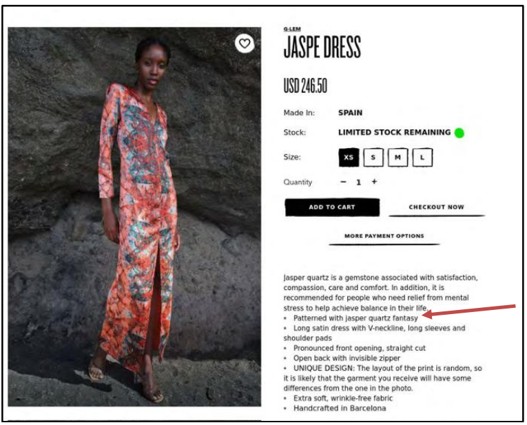
Teresa Michelle Lee filed an intent to use application to register JASPE as a trademark for various clothing items including shirts and pants. After the Examining Attorney refused registration on the ground that this mark was deceptively misdescriptive of those goods, the applicant appealed to the Trademark Trial and Appeal Board (TTAB).
Misdescriptiveness
The Examining Attorney introduced at least 7 third-party definitions of “jaspe” fabric, and 13 third-party retailers selling “jaspe” clothing.
Applicant made a number of arguments to refute the conclusion that its mark was deceptively misdescriptive of the goods. The TTAB found each of them unpersuasive after detailed consideration:
- “Jaspe” lacks a consistent, stable, commonly understood meaning that would immediately describe a feature of the goods, so JASPE is a unique mark adopted by Applicant. The extensive evidence of the descriptive use of “jaspe” for clothing undercuts that assertion. Analogously, “cotton” fabric lacks a uniform appearance or texture but still identifies a type of fabric.
- “Jaspe” does not have a widely recognized definition because some dictionaries do not mention it. This may show that the word is not yet in widespread use, but it may be misdescriptive even to only a subset of relevant consumers. Furthermore, consumers are likely to know the meaning of the word due to definitions by various clothing industry members.
- The word “jaspe” does not appear in the Federal Trade Commission’s Textile Fiber Products Identification Act. This is not determinative of consumer perception.
- Some third-party clothing retailer websites do not refer to “jaspe.” Perhaps those retailers do not sell such clothing.
- There are other definitions of “jaspe” relating to a red gemstone, a common last name, or (as in this case) a first name. Other meanings are not controlling.
- Applicant’s intent in adopting the proposed mark was as a meaningful tribute to her son, Jasper. Intent for adopting a mark is not relevant.
- Since “jaspe” means “jasper” in Spanish, consumers will immediately associate the JASPE mark with the jasper gemstone. The proposed mark is an English word, so its foreign language meaning is not applicable, and no case has applied the doctrine of foreign equivalents to overcome a deceptively misdescriptive refusal.
- Many third-party marks have been registered incorporating terms that could suggest a material, like “velvet” or “canvas.” None of these marks included the word “jaspe,” and each was a composite mark whereas the mark JASPE is a single word.
There were no restrictions on the goods identified in the application, so they could feature a jaspe fabric or design as a significant feature. However, Applicant had stated to the Examining Attorney that none of its specified goods contain a jaspe textile.
Thus, the TTAB held that the word “jaspe” merely describes a significant feature—fabric or design—that Applicant’s shirts and pants might plausibly possess but in fact do not possess. This made the mark misdescriptive of the goods.
Consumer Perception
TTAB concluded in a single paragraph that a reasonably prudent consumer would be likely to believe the misrepresentation that the goods are made of jaspe textiles.
Accordingly, the TTAB held JASPE to be deceptively misdescriptive of the clothing items. There was no secondary meaning claim since this was an intent to use application. Consequently, the TTAB affirmed the refusal of registration.
In re Teresa Michelle Lee, Application No. 98081572 (September 29, 2026).
Author’s Note:
If a deceptively misdescriptive term would materially affect the consumer’s purchasing decision, that term would be considered to be “deceptive.” A deceptive mark is completely precluded from registration under any circumstances. We discussed this in You may not Realize that your Trademark is Deceptive.
In contrast, a deceptively misdescriptive mark that is not material to a purchasing decision may be registered on the Supplemental Register (for terms seeking to acquire secondary meaning), provided that mark is in use in U.S. commerce. In the case discussed above, Applicant had made no claim that the mark was in use.
After acquiring secondary meaning through use, a deceptively misdescriptive mark eventually may be registered on the Principal Register.
Teresa Michelle Lee also filed another intent to use application No. 97763154 to register the same mark JASPE as a trademark for yoga carrying apparatus in Class 27, and for yoga fitness equipment in Class 28. The same Examining Attorney initially refused registration on the same ground that it was deceptively misdescriptive. But that application was allowed after an amendment to add to the description of the specified goods in each class, “none of the foregoing containing or composed of jaspe textile.”
Why the different results? It may be that it would be obvious to a consumer that the Class 27 and 28 yoga paraphernalia were not made of jaspe fabric, but the nature of the fabric in Class 25 clothing might not be apparent.
For further information, please contact William M. Borchard or your CLL attorney.
 Senior Counsel
Bill has handled domestic and international trademark and copyright matters at the highest level for over 60 years. He has counseled and represented clients on domestic and international trademark matters concerning clearance ...
 RSS Feed
 Follow us on Facebook
 Follow us on X/Twitter
 Follow us on LinkedIn