
When an opposer challenges a U.S. application to register a mark that is identical or highly similar to its own unregistered mark, for identical or closely related goods or services, likelihood of confusion is not in issue. The sole issue in that opposition becomes which party has priority.
The Trademark Trial and Appeal Board (TTAB) made a 76-page detailed review of the factual record in such a case. It concluded that the opposer had not proved its service mark priority claim.
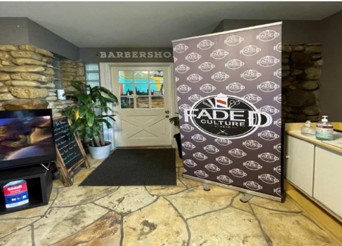
Applicant’s Interior Signage
On June 19, 2019, Faded Culture Studio, LLC (Applicant), a company owned by two brothers named DelRio, began operating a barbershop in Chicago, Illinois under the mark FADED CULTURE STUDIO. Applicant filed an intent to use application to register FADED CULTURE STUDIO (disclaiming the exclusive right to use STUDIO apart from the mark as a whole) for barbering services. Applicant later claimed that its date of first use was “as early as June 19, 2019,” the date its barbershop opened, which predated the filing date of its intent-to-use application.
Previously in 2016, FVDED, LLC (Opposer), a company owned by two brothers named Barron, had opened a barbershop in San Antonio, Texas. That shop was initially named “Barron’s Barbershop.” It was unclear when the shop changed its name to FADED CULTURE, and Opposer had never applied to register that mark for barbering services. Nevertheless, Opposer challenged Applicant’s application claiming that Opposer had prior common-law (that is, unregistered) rights in the mark FADED CULTURE for barbering services and clothing.
Priority normally goes to the first user of the mark for the goods or services. A mark is used for services when “it is used or displayed in the sale or advertising of services and the services are rendered.” Advertising alone is not sufficient if the services are not being rendered.
Sometimes priority may also rest on other facts including the filing date of an intent-to-use application, an earlier domestic registration (or in some cases a foreign application filed in the preceding six months - see our article Trademark Law Alert--Cross-Border Trademark Priority), or certain preliminary uses of the mark that do not technically qualify as trademark or service mark uses - see our blog post Prior “Use Analogous to Trademark Use” May Win.
Applicant’s Use. Applicant attempted to establish a priority date earlier than its claimed June 19, 2019 use date based on various pre-opening activities. These activities included the selection of its mark, the launch and use of its mark on social media accounts, and the installation of a floor decal bearing its mark in its barbershop. The TTAB rejected this evidence as not being clear and convincing, and as mere advertising before Applicant actually began to render its barbering services.
Opposer argued that Applicant’s priority date should be later based on Applicant’s Instagram posts, which dated from as early as June 27, 2019, stating that it was “opening very soon.” Applicant said that this referred to its “grand opening” on August 17, 2019, not the commencement of business operations.
Applicant’s uncontradicted testimony established that Applicant first performed barbering services on June 19, 2019, the date of first use claimed in its application. Photos showed the mark on the exterior and interior signage that existed on that date. Accordingly, the TTAB found that Applicant’s priority date was June 19, 2019.
Opposer’s Use. The following summarizes Opposer’s main arguments:
- Variations of Opposer’s Mark. Before June 19, 2019, Opposer had used various marks including FADED, FVDED, FXDED, F∀DED, FɅDED, FXDED, with or without CULTURE, on clothing advertising its barbering services. Opposer argued that these marks were “stylistic variations” or “minor stylistic displays” having the same continuing commercial impression as the FADED CULTURE mark. The TTAB rejected this argument as not being supported by the cases relied upon by the Opposer.
- Opposer also argued that it could tack its use rights in FADED CULTURE for barbering services to its use of these other marks on clothing. Tacking must be pleaded, and the TTAB found that Opposer’s pleadings and brief had not adequately put Applicant on notice that it intended to pursue this issue. Furthermore, for tacking to apply, the goods or services must be substantially identical. Although the TTAB found that the parties had tried this issue by implied consent, it rejected the tacking claim since clothing and barbering services are not “substantially identical.”
- Testimony About Use. Opposer relied on declarations by a dozen “friends and customers” who testified that Opposer had given them haircuts using the name FADED CULTURE. After many pages of discussion, the TTAB found this testimony “characterized by contradictions, inconsistencies, and indefiniteness” in that it provided different first use dates, different variants of the mark, and different ways in which the mark was used. The testimony that the Barron brothers “were talking about FADED CULTURE a lot” did not detail any goods or services related to that term, and the TTAB said, “‘talk is cheap’ and it does not buy priority.”
- Promotional Goods. Sales to Opposer’s customers of a few shirts bearing the FADED CULTURE mark, even if intended to promote Opposer’s barbering business, did not give Opposer priority because the barbering services were not being rendered under the FADED CULTURE mark at the time of the shirt sales.
- Use Analogous to Trademark Use. Opposer’s use of FADED CULTURE and variations on social media posts generally were mere lifestyle commentaries, and in any event, they did not qualify as “use analogous to trademark use” because the barbering services were not being rendered under the FADED CULTURE mark at the time of those posts.
- Other Possible Evidence. The TTAB noted that conspicuously absent from Opposer’s pre-2019 evidence were any of the normal trappings of the use of a mark for barbering services, such as signage, local newspaper advertisements, regulatory licenses, and inspection reports displaying the FADED CULTURE mark.
The TTAB concluded that, on this record, it was “more likely than not” that the Barron brothers were not giving haircuts using the FADED CULTURE mark before June 19, 2019.
Accordingly, the TTAB dismissed the opposition based on this failure of Opposer to establish its priority
Author’s Note:
The unsuccessful arguments made in this case nevertheless may be instructive as to how an opposer might succeed in a different priority dispute.
Furthermore, in the opinion’s first footnote, the TTAB suggested a possible alternative approach: Instead of one party “having to take a proverbial haircut with respect to its rights,” the parties might have been able to obtain geographically limited federal registrations via a concurrent use proceeding or a negotiated settlement.
This suggestion was based on the TTAB’s observations that Chicago and San Antonio have a geographic separation of more than 1,000 miles, the nature of barbering is face-to-face, and there had been several years of coexistence.
Since the parties had chosen to fight it out instead of seeking to coexist, the TTAB had to decide “the essentially winner-take-all case that they litigated.”
Despite Applicant’s success in obtaining a national service mark registration, Opposer is likely immunized from an infringement attack by Applicant. Opposer claimed it could prove technical use of the FADED CULTURE mark in San Antonio “at least as early as May 2018.” This use predated the April 6, 2022 filing date of Applicant’s intent to use application, so Opposer may have established senior common-law service mark rights in its local geographic area.
Nevertheless, Applicant could challenge any expansion by Opposer to another geographic area if that expansion occurs after Applicant’s filing date and if Applicant itself expands its business into that area.
FVDED, LLC v. Faded Culture Studio, LLC, Opposition No. 91286343 (T.T.A.B. November 2, 2026).
For further information, please contact William M. Borchard or your CLL attorney.
 Emeritus
Bill retired from the practice of law and now focuses on writing informative and engaging articles on intellectual property law developments. Before retiring, he handled domestic and international trademark and copyright ...
 RSS Feed
 Follow us on Facebook
 Follow us on X/Twitter
 Follow us on LinkedIn